Posts

UDL Lesson Planning

Image
I am teaching addition in my Kindergarten classroom. My students should be able to use single digit numbers that add up to 10. I need to access my students to see what level they are at with addition. Here are many ways to assess students with ID, starting with the material being taught. The two ways to go about teaching material is formative and summative, both are good ways depending on how the students understand what is being taught. Once material is presented some forms of assessment can be done via homework, observation of how the student is performing in class and 1 on 1 asking the students questions. How the student learns is different by the student, some learn with groups while some learn individually, some learn with noise and some learn with silence, because of these differences, room setup is crucial for their learning of the subject (Do-It, 2022). For students with alternate disabilities including blind, mute, deaf or different language, universal design technologies for...
Universal Design Learning

Image
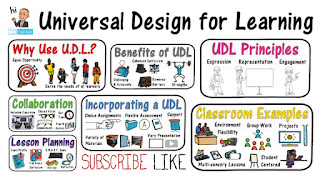
1. When the teachers are making goals for the students using the principles of UDL, teachers need to keep in mind of the diversity in their classrooms. Not every student learns the same and will have different talents, interests, and abilities. The lesson plans should provide multiple ways of representing the lesson, expressing the lesson, and engaging in the lesson. Our students come from all different backgrounds we need to set up the classrooms for diversity.  2. The way I will present the unit on plants to my 2nd grade students is asking my students "Hey my friends, what do we know about plants?" My students will provide their responses, which sparks up their interest into learning more about plants. After this, we will transition into the PowerPoint identifying key points from the textbook. There will also be options during the PowerPoint discussion like digital text based off of the videos in the slideshow, open captions in the videos, handouts on key points of what was...

What is Assistive Technology?

Image
       Assistive technology is technology that assists you in some way. If you have a disability and may need help with a number of things or an easier to open the door or a more comprehensive solution, assistive technology can help.   Examples of low technology are walking canes, binder clips to assist with reading, for sensory purposes a fidget or stress ball, if you want to communicate the student can write words down. For kids who have difficulty seeing papers with larger fonts will allow the child to be more engaged in the classroom. Low assistive technology is technology that doesn't require training or electronics. Other examples of low assistive technology are pencil grips, adapted pencils, and using colored highlighters to organize the classwork.        Medium technology is technology that is simple to use. It is in between low- and high-tech devices. It may be battery operated and use simple electronics. Examples of medium...

Useful Technologies

Image
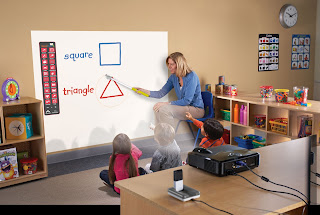
 In my VPK classroom I will be incorporating traditional as well as cutting-edge technology. Both of these types of technologies will serve a different purpose in how the kids learn. Some examples of traditional technologies include white boards and projectors. The main purpose of the whiteboard is for kids to see the days of the week and the assignments of the day. The white board will also be used for drawing shapes and interacting with the students, measuring their abilities of copying shapes and their understandings of the material being discussed. This would be used during circle time when I have their undivided attention. The projector is another form of traditional technology I would incorporate in the classroom in the beginning and end of class time to show the students their work and homework. This would help the students by allowing me to show the students what they would be expecting, how to do some with them and allow time for questions. Some cutting-edge technology I w...
Image
 I believe young children learn through play. As part of their growth and development, learning through play is very effective for many reasons. Young children can increase their motor skills, develop language, learn real life situations through dramatic play, explore scientific theories, sort objects mathematically, get an understanding of different emotions, use self-control, gain a positive self-concept, and an interest in social studies. (multicultural). Best of all, the children won't even know they are learning because they are interested in the activity. When the activities are planned for each center that is purposeful and developmentally appropriate for the age group; the possibilities are endless.  Based on the children learning through play, I believe in actively watching the children at all times. Checking each individual center to make sure everyone is understanding the activity that has been provided. If not, teach them individually about how the activity works. ...
Image
 Welcome to Miss Carinna's VPK class! I am so thrilled to be teaching all of the important skills needed to prepare you for kindergarten. This year will be filled with educational games, learning activities, group assignments, centers, arts and crafts, and more! I can't wait to get to know all of you this school year. Let's get to learning and have a great year.